Category: Weather History
Two Years Ago Today
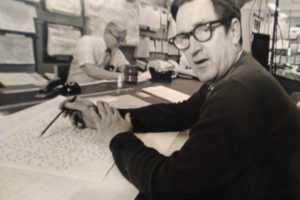
Photo from Tommy Mosley
I often wish I was a writer, like Rick Bragg. But, God chose not to give me that gift. It is for that reason I always struggle to write what I feel on this day.
It is my belief we are born to accomplish certain goals. To be at specific places at a moment in time. Whether your life lasts six hours, or ninety nine years. We all have a defining moment; all of our life experiences, lessons, and knowledge take us to that moment. If we are ready or not.
For me it sure seems like I was meant to be on the big green wall April 27, 2011. My friend Jason Simpson was meant to be in that studio with me. There is no manual or guide on covering 62 tornadoes in one day; you just have to do the best you can. I could not have asked for a better partner than Jason. He is one of the smartest guys I know, and loves the people of this state.
We were so far from perfect that day. Our primary radar system had the pixels displaced five miles to the south, leading me to call tornado locations that were “off” slightly on two occasions. The morning round of storms knocked out many of our cameras, and much of the infrastructure we rely on at ABC 33/40.
But, we did the best we could under the circumstances. I stopped playing mental gymnastics a year ago, and now I am simply focused on making the severe weather warning process better. There is no way, and I mean no way, 252 people should have died that way, when tornado warning lead times were generally between 25 and 50 minutes. Plenty of time to get to safety.
Sure, in come cases there was nothing you could do. It was just their day. We all have an appointed day to die. But for so many they didn’t have to lose their life April 27, 2011.
You can go through my social media accounts and see pictures and stories…
But the point of this post is to let you know we have worked hard over the past two years to make the warning process better. No, there is a very, very good chance we won’t have another April 27 for at least forty years. But, all it takes is just one tornado in the entire state, and if that one comes through your neighborhood, then that becomes YOUR April 27.
Here is some of the progress…
*The false alarm ratio for tornado warnings issued by the National Weather Service in Birmingham has been cut in half since April 2011. This will reduce the “cry wolf” syndrome, and make people take warnings seriously. My friends at the NWS here have done an remarkable job in making this happen by going back to basic science.
*We have expanded the ABC 33/40 SKYCAM network at a rapid pace, and new cameras are in the pipeline that will go online soon. We have learned that a live stream of a tornado will make people take cover; often people see extremely dangerous radar signatures as simply buckets of spilled paint. We must get cameras on as many tornadoes as possible.
*Our aggressive “NO SIREN” campaign is working. The siren mentality has killed countless numbers of people in our state; the notion that you will hear an outdoor warning siren before a tornado. Our push to get NOAA Weather Radio receivers in all homes, businesses, and churches, along with smart phone apps like MyWarn and iMap WeatherRadio, is paying off.
*The idea of having a severe weather kit with items like shoes, air horns, and helmets is also catching on. More and more Alabamians are getting on board.
Please take a few minutes today and say a prayer for those that went through the worst of April 27, 2011. You will never know the pain, but at least we can cry with them and say an encouraging word. We mourn the 252 that died, but celebrate those that are alive today.
I am looking forward to seeing my friend Mayor Walt Maddox of the City of Tuscaloosa; we will be “guest coaches” at the UAB spring football game today at the west soccer field on the UAB campus. He leadership in the days after April 27 was an example for us all. Mayor Maddox represented the state so well. UAB players will all have 4.27.11 on their helmets as we remember that day with wonder, sadness, and awe.
Please remember the state of Alabama in your prayers today.
The 1956 McDonald’s Chapel Tornado
Headlines on Sunday, April 15, 1956 talked about Democratic Presidential hopefuls Adlai Stevenson and Estes Kefauver and their attacks on President Eisenhower’s foreign policy. Eisenhower still had a firm lead in recent polls that showed him a clear winner if he was to run against Kefauver. The U.N. Secretary General was in Lebanon working on the Israeli/Egyptian crisis.
Locally, Jabo Waggoner was running for Associate City Commissioner of Public Improvement. Major league clubs were closing down their spring training camps and heading for Tuesday opening games. The Yankees and Dodgers were favored to win their respective pennants, again as in 1955.
The Birmingham News put the official U.S. Weather Bureau forecast on the top of the front page back then. The paper called for Considerable cloudiness, windy and warm Sunday and Sunday night with scattered showers and thunderstorms. Winds 15 to 30 mph. Sounded like tornado weather. It was.
Around 3 p.m., an F4 tornado tore across the western and northern fringes of Birmingham. It touched down just west of Wylam. The tornado plowed through McDonald’s Chapel and the Stacey Hollow area. One hundred homes were destroyed in these two communities. The murderous tornado continued through Sandusky, destroying twenty blocks of homes.
It then hit the Sayreton area just north of North Birmingham and destroyed a filling station and barbecue restaurant along US-31 in Fultondale. Homes were destroyed in the New Georgia community between Sayreton and Lewisburg. The tornado passed just north of Tarrant City, near Ketona, finally lifting near Chalkville.
Other neighborhoods that were hard hit were Capps Town and Oak Ridge. A Capps Town resident said that the tornado looked like “a big ball of fire rolling in big black smoke. It just roared, roared, roared,” she said. The only warning anyone had was the sound of the tornado.
The twister killed 25 along its 20 mile path. Most of the deaths occurred in the Stacey Hollow and McDonalds Chapel communities, save for two young sisters in the Sandusky area. Over two hundred people were injured and eleven hundred left homeless. A total of 400 homes and buildings were destroyed.
On This Date, Fifteen Years Ago
An EF-5 tornado tore through the western suburbs of Birmingham, killing 32 people, and injuring over 250 others in places like Oak Grove, Rock Creek, Sylvan Springs, McDonald Chapel, and Pratt City. More than 1000 homes were destroyed and more than 900 homes with significant damage.
The tornado track was 30.6 miles long and at it’s widest point was half a mile wide. After first touching down on the east side of the Warrior River in Tuscaloosa County, the tornado crossed into Jefferson County at 7:52 pm moving just south of the town of Scrap, just inside Jefferson County. It traveled east-northeast impacting Oak Grove, Concord, Pleasant Grove, Edgewater, McDonald’s Chapel areas before ending in Pratt City. The storm reached it’s strongest intensity producing F5 damage in the Concord area and the McDonalds Chapel/Edgewater area.
Interestingly, the tornado was on a trajectory that if it had stayed on the ground for an additional two or three miles the high rises in downtown Birmingham would have been affected; four more miles and the Birmingham Airport would have seen the destruction as well.
The same parent storm dropped another tornado in St. Clair County, killing two near Wattsville north of Pell City.
On This Date In 1977…
SMITHFIELD TORNADO: The tornado began around 3 pm CST, 4 miles northwest of Birmingham near U.S. Highway 78, and then traveled northeast for 15 miles at 60 mph, crossing Interstate 65. At it’s widest point, the tornado was 3/4 of a mile wide. Over 150 homes were damaged with almost 50 completely destroyed. A total of 22 people were killed with over 130 injured. This one storm alone caused over $25 million in damage ($83 million in today dollars). Daniel Payne College near U.S. Highway 78 sustained heavy damage from this massive tornado with estimates over $1 million dollars. The college, opened in 1880, later closed its doors in 1977, likely a result of the enormous cost and amount of damage. There were six other tornadoes on this day including five F2 tornadoes and an F3 tornado across North and Central Alabama.
Timely tornado warnings provided by the National Weather Service allowed people to take necessary action well ahead of the approaching storm. The new NOAA Weather Radio program played a huge role in the process. Warnings were broadcast live on the Birmingham KIH-54 transmitter which was just implemented five months prior to this event.
Many people do not know that the famous Dr. Theodore Fujita, for whom the Tornado Fujita Intensity Scale is named after, followed this massive tornado and supercell thunderstorm from an airplane. After tracking the storm, Dr. Fujita surveyed the damage and toyed with the idea of rating the Smithfield tornado an F6. (thanks to the Birmingham NWS for this summary).
Our own J.B. Elliott took many, many damage pictures for the National Weather Service…
This story was produced by ABC 33/40 back in the 90s (thanks to Mike Wilhelm for putting this up on YouTube)
See more pictures and meteorological data from the event here from the NWS Birmingham.
PASSENGER JET DISASTER: The same thunderstorm complex was responsible for the crash of Southern Airways Flight 242 in Georgia; it was a flight from Huntsville to Atlanta. The passenger jet went down after suffering hail damage and losing thrust on both engines; Sixty-three people on the aircraft (including the flight crew) and nine people on the ground died; twenty passengers survived, as well as the two flight attendants. One of the initial survivors succumbed to his injuries several weeks later.
On This Date In 1974…
At the time it was the greatest outbreak of tornadoes on record in the U.S. The famous “superoutbreak” of tornadoes started… A total of 148 tornadoes swept across 13 states in roughly a 24 hour time frame. From Illinois to North Carolina and from Michigan to Alabama, tornadoes and severe thunderstorms killed 335 people and injured over 6,000. Over 15,000 homes, businesses and farm buildings were destroyed and another 17,000 buildings were damaged. Here in our state, 86 persons were killed, 949 were injured, and damages exceeded $50 million. Sixteen counties in the northern part of the State were hit the hardest. The town of Guin, in Marion County, was just about wiped out by a massive F5 tornado.
Our own J.B. Elliott at the time was working for the National Weather Service, and was on duty that night. We put this story together several years ago…
Warnings like this were issued that night…
I was a senior in high school in April 1974, and I spent several days away from school serving as an amateur radio volunteer in some of the hardest hit areas. That experience would change my life, and set the stage for the long career in weather.